There’s a little world under the text on this site’s front page: sand, water, trees and a crowd of stick-figure guys who fell trees, dig and build towers. The goal is to be able to leave a random world alone and come back to a screen full of business, like an ant farm.
To make “busier” something I can measure, there’s a benchmark. It takes 32 random worlds (8 seeds, each laid out like the real front page at laptop, HD, tablet and phone sizes) and leaves each alone for 100,000 ticks, about 40 minutes on the page. The score is how much of the screen the guys have changed (built on or dug out), in thousandths of the screen, minus a penalty whenever a guy gets stuck: stranded somewhere, walking without getting anywhere, or going round in a loop. A guy who simply has nothing left to do isn’t counted as stuck. The headline number averages the whole run, with the early part counting a bit more, so getting going quickly matters.
The rules: anything the guys do can change, but the terrain generator and the materials can’t.
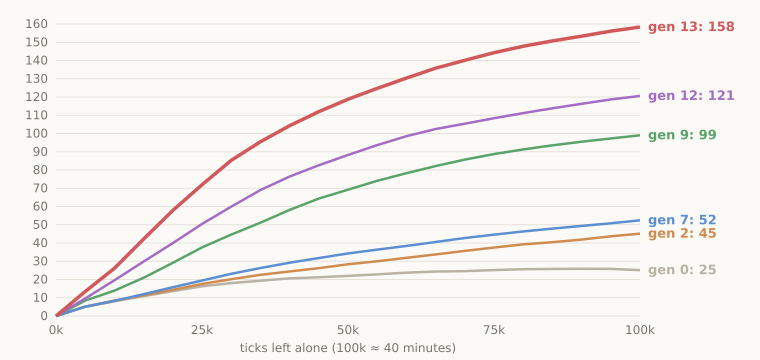
| generation | score | after 40 minutes | worst world |
|---|---|---|---|
| 0: where it started | 18.5 | 25.1 | -52.9 |
| 2: the nest | 24.4 | 45.1 | 13.3 |
| 4: stores and swimmers | 24.7 | 44.9 | 13.3 |
| 6: more diggers, sooner | 27.8 | 51.4 | 6.7 |
| 7: into the hills | 28.5 | 52.4 | 16.2 |
| 8: everyone pitches in | 50.3 | 88.5 | 20.6 |
| 9: the long way round | 55.8 | 99.0 | 21.4 |
| 10: winzes | 64.1 | 118.1 | 47.8 |
| 11: nobody left behind | 66.9 | 121.5 | 49.8 |
| 12: many hands | 71.0 | 120.6 | 53.7 |
| 13: up the scaffolding | 96.0 | 158.3 | 45.1 |
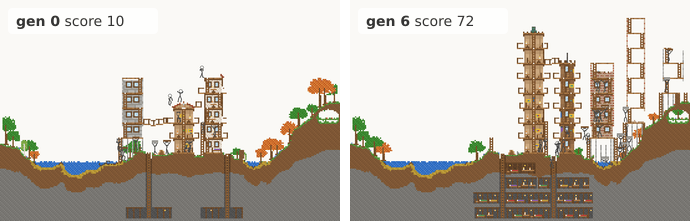
The same tablet world after 40 minutes, at the start and now.
Gen 0: where it started
The guys built a handful of towers and then ran out of things to do, and crowds stood about at home. Phones were worst: the text leaves only a thin strip of sky, so there’s barely room for a tower, and one phone world built nothing at all. Meanwhile the whole ground band, a sixth of the screen, sat untouched apart from a single mine.
Gens 1 and 2: the nest
A finished mine now becomes a nest. The guys keep carrying its galleries further and opening new levels off the shaft, always through solid ground, propped up with timber posts and lit with lanterns. Finished stretches of gallery become rooms that get furnished with beds and tables, and furniture attracts newcomers, so even a phone can grow a town underground.
They also carry three times as much wood per trip. Before, guys spent 55% of their time walking to building sites, 24% walking to the stockpile and about 1% actually building, because one load was only half a storey.
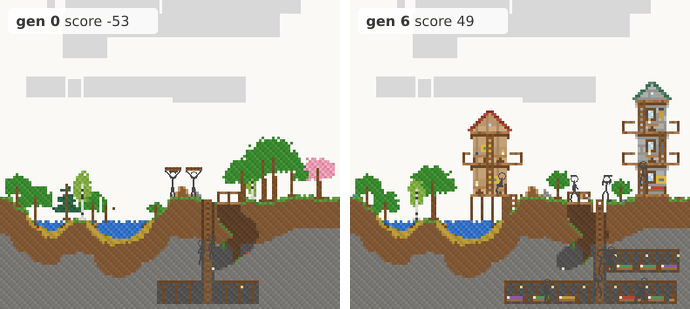
A phone world: before, two guys standing on a hill; now towers and a furnished nest.
Gens 3 and 4: stores and swimmers
Every mine shaft gets its own little store of wood and stone at the top, so diggers don’t trek home for timber. Spreading mines out across the whole screen sounded good but made things worse (crews spent their time walking to far-off shafts), so mines stay near home.
Gens 5 and 6: more diggers, sooner
The first mine was one enormous job, and the nest didn’t open until about 50,000 ticks in. Now a new mine is just a shaft and a short starter gallery, and the nest opens in half the time. From there, lots of small crews of two dig different galleries at once, instead of everyone waiting on one.
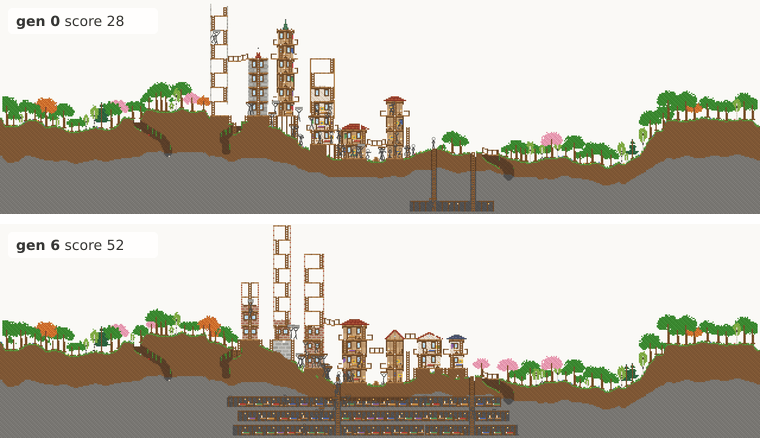
An HD world: the same towers, and now three levels of rooms under the town.
Gen 7: into the hills
The weakest worlds were mountain tops: nowhere flat enough for a mine shaft, so nothing got dug at all. When no shaft fits, the guys now drive an adit, a tunnel straight into the hillside from a ledge they can stand on. It starts as an open cutting, gets roofed over and propped with timber as it goes deeper, and once it’s done it becomes a nest like any other, with its own store and rooms. The worst of the 32 worlds now scores 16 instead of 7.
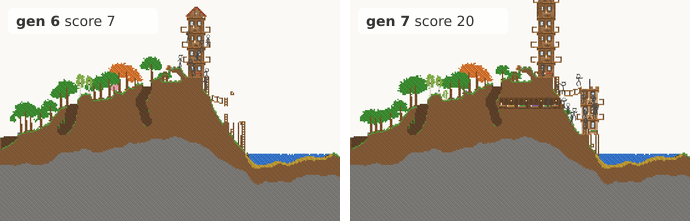
A mountain-top tablet world: before, one tower and nothing dug; now a tunnel through the hill, with a store at its mouth.
Gen 8: everyone pitches in
Watching where the guys’ time actually went was eye-opening: over a third of it was spent wandering about with nothing to do, while the stores held thousands of planks and stone. Three things were holding them back:
- One mine at a time. Mines could only go near home, the shaft had to reach the very bottom of the screen, and only one could be dug at once. Now there’s a mine on the go for every dozen guys, anywhere on the screen, near a store but away from the other nests, and as deep as the ground allows. That’s how the colony spreads out.
- Crews with nothing to do. Guys signed up to big tower crews even when every job within sight was already taken, then wandered off. Now they only join a project that has work going.
- Pointless trips to the store. A guy with an armful of wood whose next job was digging would carry it all the way back to the store, dig, then fetch it again. Or they’d run off to whichever project happened to be first on the list, often the far side of the map. Now they keep it while their own job still needs it, and otherwise takes it to the nearest job that does.
With all that, there’s enough work for a bigger town, so wide screens can now grow to 72 guys.
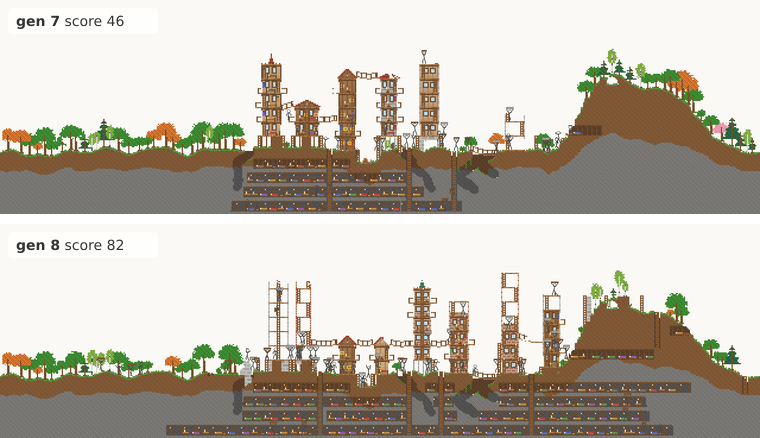
An HD world: twice the score, with the nest dug the whole way across.
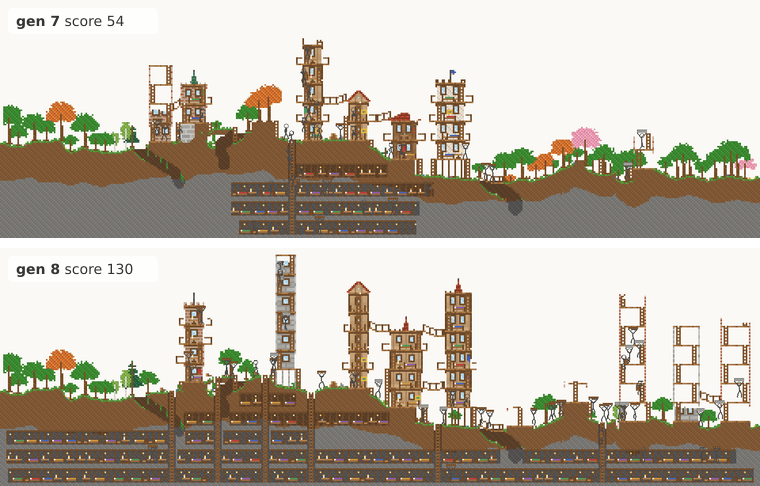
A laptop world: a second village is going up on the right, over its own nest.
Gen 9: the long way round
With everyone busy, the next waste was walking. A few things were sending guys the long way round:
- Lakes over the nest. A gallery wasn’t allowed anywhere with water or sand anywhere above it, even with solid ground in between, so a lake on the surface cut the nest in two. Now it only needs a solid roof, and the galleries run right under lakes.
- Swimmers turning back. Every ripple on a lake made a swimming guy think the way ahead had gone, so they’d stop, rethink, swim a few strokes and stop again. Crossing a lake could take a thousand ticks.
- Picking the emptiest job, not the nearest. A guy finishing up would trek across the map to a project with one more free slot, instead of joining the one next to him. Now they join the nearest job that wants hands, and mine shafts don’t take more diggers than fit.
- Wood. The woodpile kept running dry, so every store now gets its own wood lot planted around it.
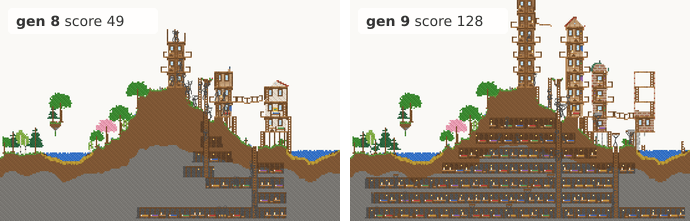
A tablet world: the hill is now an ant hill, hollowed out level after level.
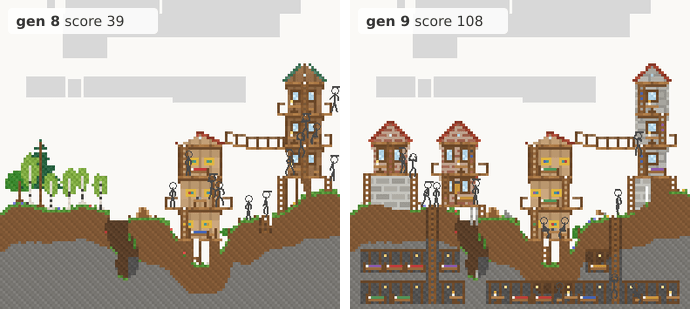
A phone world: from a couple of towers to a village over two levels of nest.
Gen 10: winzes
New levels of the nest could only be opened off the main shaft, every twelve rows. A cave, a lake or just the shaft being in the wrong place left whole stretches of ground out of reach, and small screens ran out of digging by about a third of the way through.
Now a gallery can sink a winze, a little ladder shaft of its own, twelve rows up or down to start a new level, as long as there’s solid ground all the way. So the nest grows in every direction, a level at a time, like a real ant nest. Rooms it cuts through are split around the hole, and no winze goes where there’s furniture.
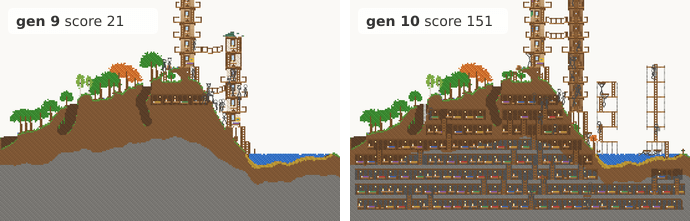
The mountain-top world that used to be the weakest: now the whole mountain is a nest.
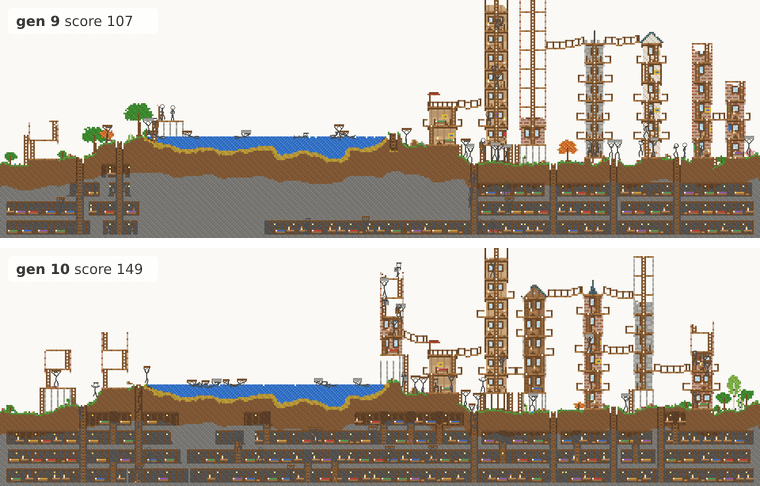
A laptop world: the far shore of the lake finally gets dug, and there are levels all the way along.
Gen 11: nobody left behind
A generation of bug fixes, found by hunting down where the stuck-guy penalty came from:
- A tower that cut the colony in two. A tower’s stone foundation went down right across the only path to a whole nest, and dozens of guys found themselves stranded underground and gave up. Towers were checked for this when they were planned, but nests grow, and a path that didn’t matter then can matter a lot by the time the stone goes down. Now every solid block is checked as it’s placed, and if it would wall off part of the colony the builders leave a doorway instead.
- Five guys frozen at a lake’s edge. A tower went up over the next spot on their path while they were treading water, and they flicked between “falling” and “hopping” forever, so they never stopped to think again.
- Swimmers who couldn’t be rescued. A guy stranded in a lake would plan a rope ladder down to the lake bed, which they couldn’t reach. The ladder now stops at the water.
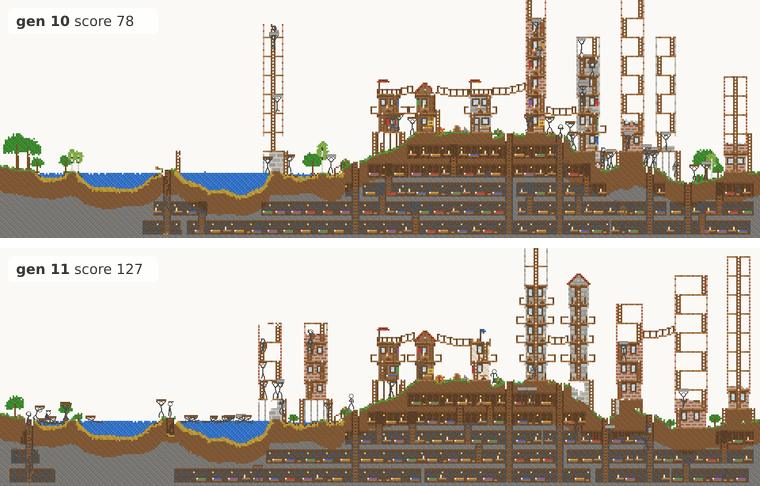
The laptop world with the five frozen guys: nobody is stuck now, and it shows.
Gen 12: many hands
Early on, a third of the guys had nothing to do: every project already had a full crew, and the planner only kept one project on the go for every three guys. Now it’s one for every two. The colony ends up in the same place after 40 minutes, but it gets there much sooner, and that’s what the page is for: most visitors only see the first few minutes.
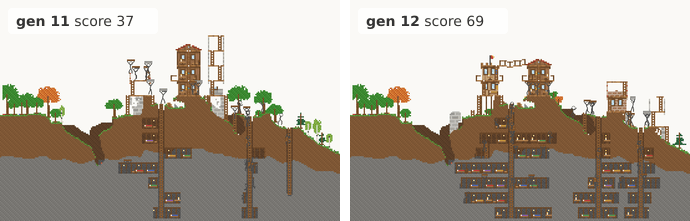
The same tablet world 12 minutes in: twice as much nest.
Gen 13: up the scaffolding
Towers were being started and not finished: guys would climb all the way up, put in a plank or two, and come back down. Counting every trip showed why:
- Too many cooks. A guy only looks a dozen steps ahead in the blueprint, so a crew of six would use them all up and the next climber found nothing left to do. Now the bigger the crew, the further ahead they look.
- The wrong armful. A guy carrying stone would pick the nearest step even if it needed wood, then go back down to swap it. Now they pick a step they can pay for with what he’s carrying first.
- Waiting on a guy in the way. If someone was standing where a block had to go, the builder waited, and waited, then gave up and left. Now the builder sets that one aside and carries on with the next.
That made the colony so much quicker that some worlds ran out of trees they could reach. Two fixes:
- A balcony plank could block the gap a guy hops up through, which the doorway check from gen 11 missed, and that cut off a whole forest. The check now covers ledges as well.
- When the woods within reach run low and there are trees down a drop the guys can’t climb back up, they hang a ladder down to them.
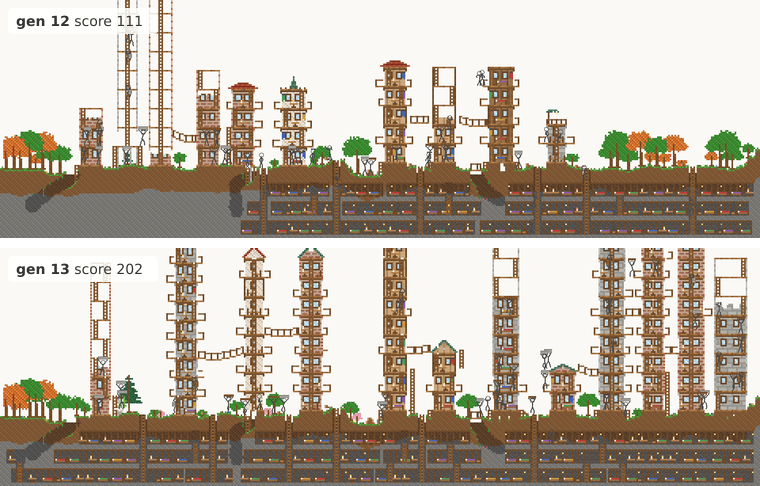
A laptop world: twice the score, and the towers actually get finished.
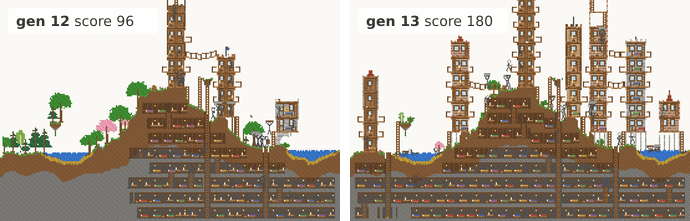
A tablet world: a whole town of finished towers on top of the nest.
Little things fixed along the way
- Reloading the page lost track of what everyone was doing, and a big world’s save could quietly fail once the browser’s storage filled up, so a reload brought back an old world. Saves now keep everything (each guy’s job and route included) in half the space, a reloaded world carries on exactly as if it had never stopped, and a full store makes room for the current world.
- Working out where the guys can safely walk was most of the simulation’s running time. It’s now twice as fast, with exactly the same answers.
- Swimmers stopped and turned around every time a ripple passed under the next stroke.
- An abandoned mine kept its place on the to-do list, and its ground, forever, so that world never tried another one.
- Stuck builds: a guy who couldn’t reach the next step of a build never gave up on it, so whole projects stood still for good. One phone world planned the same unreachable tower 13 times.
- Swimmers flickered between swimming and falling as ripples passed under them, sometimes bobbed in place for thousands of ticks, and couldn’t swim across lakes to fetch wood. A swimmer trapped in a pit never asked for rescue.
- Felled trees now topple over and break up instead of vanishing.
- The material menu on the front page opened behind the world instead of on top of it.
- After hovering a link, pressing reset made a world thousands of pixels tall, with the ground way down the page. The site keeps hidden previews of linked pages around, and the world was making room for their text.
- On phones, the material menu ran off the edge of the screen.
- Going to another page and back with the browser’s buttons could leave the world drawn in streaks, and the world was saved under the wrong page’s name on the way out, so coming back started a new one.
- The mouse’s back and forward buttons poured sand. Flipping back and forth between pages also slowed the whole browser down: the site’s link graph never stopped its old copies, so each visit left another one running, and the world’s menu left a listener behind every time.
- Clicking around quickly could make the whole site run twice. The site swaps pages by comparing the old page and the new one element by element, and the world’s canvases sat at the very top of the page, so everything looked changed. The site rebuilt every element, its own code included, which then ran a second time, with two of everything from then on. The canvases now go at the bottom, and the site’s code is marked to never run twice anyway.
- Resizing the window regenerated the world on every pixel of the drag and filled up the browser’s storage.
- The benchmark itself got about 4× faster: the falling-sand step was checking every cell of the screen every tick, even though nearly all of it is still ground and empty sky. It now skips rows with nothing loose in them, and plays out exactly the same.
Still to do
- Stone piles up by the tonne with not much to spend it on.
- Trees grow back slowly, and colonies that use up their woods slow right down.
- Phones are still the weakest screens: there’s barely any flat ground to dig a mine from.
- Guys still walk far more than they work.